The Work Between Insight and Action
We’re working right now in a moment where decisions feel heavier than they used to.
There’s no shortage of information. Reports, data, opinions, and expert advice are everywhere. Yet many leaders and organizations still find themselves unsure about where to focus, how to move forward, or whether the decisions being made will hold up over time, and especially when their impact extends beyond immediate outcomes and into people’s lives and the environments we all share.
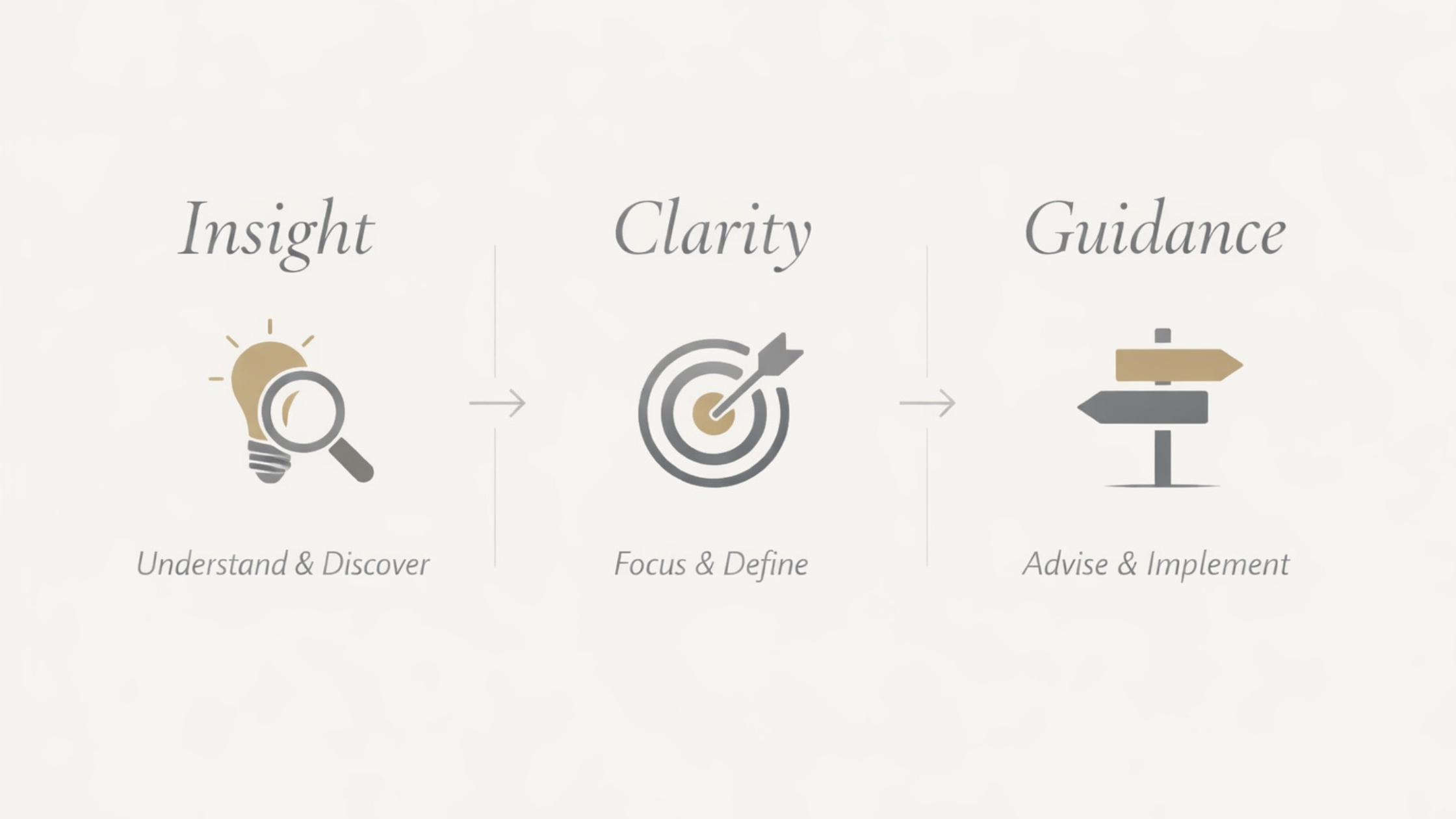
The Framework
In my experience, the difficulty isn’t a lack of insight. There’s plenty of understanding on the table. And it isn’t an absence of action either, things seem to be moving, sometimes a little too quickly. The tension tends to live in the space between the two.
That space is where clarity should exist.
Clarity isn’t about having all the answers, and it’s not the same as certainty. It’s the work of slowing down just long enough to make sense of the complexity of it all, to distinguish what’s essential from what’s urgent, and to define direction before momentum takes over. When that work is rushed or bypassed, even the thoughtful, most well-intentioned decisions can begin to unravel. Efforts become fragmented. Priorities compete. The consequences for people and for the planet treated as secondary, addressed later if time allows.
Design, when understood beyond the surface-level aesthetics, offers a way of thinking through all of this. At its best, design helps us notice patterns, understand relationships, and anticipate impact. It asks us to look at systems rather than isolated parts, and to consider not just what we are creating, but who and what it will ultimately serve.
Over time, I’ve noticed that the decisions that endure, those that feel grounded, responsible, and aligned; move through a natural progression. First comes the work of understanding: listening closely, observing the context, and being curious about what’s really happening beneath the surface. From there, focus begins to emerge. Complexity is distilled into priorities, trade-offs are acknowledged, and direction becomes clearer. Only then does guidance carry real weight, shaping actions that are intentional rather than reactive.
This process isn’t flashy, and it doesn’t always feel efficient in the moment. But it does create space for better decisions, those that account for human experience, long-term resilience, and environmental responsibility, not just the short-term wins.
When clarity is treated as optional, the costs are rarely immediate. They show up later on, and they are borne by communities, systems, and ecosystems that had little voice in the original decision-making process. Let’s be clear, taking the time to think well, to frame challenges carefully, and to align intent with impact is not about slowing down progress. It’s about acting with care.
Right now, with so much change and uncertainty, clarity becomes a form of leadership, does it not? Not every challenge requires a faster solution. Some require better questions, deeper listening, and the willingness to pause before moving forward.
How we arrive at decisions matters. And in moments where those decisions affect both people and planet, that middle space, the one between insight and action, is where the most meaningful work happens.
If this way of thinking resonates, this is the space where I work; between insight and action. More about my approach can be found here.